Tasks
Tasks are the work that comes out of conversations: a promise to call someone back, a refund to chase, a reminder to reply in the morning. Tickets are support requests that can wait in a queue until someone picks them up. The Tasks page is where you see what is assigned to you, what you are following, everything your organisation is working on, and each queue's backlog. It is also where new tasks and tickets are raised.
Two kinds of work
- Task: work for one person. It always has an assignee, and its status is Open or Done.
- Ticket: a support request about a user. It can sit unassigned in a Business Unit's queue, carries a category, and has four statuses: Open, Waiting, Resolved and Closed.
Every row opens in The Task Window, where the work itself happens. Tasks can also be raised without leaving a chat (see Tasks from a Conversation) and drafted by the AI Task Assistant.
The Tasks Page
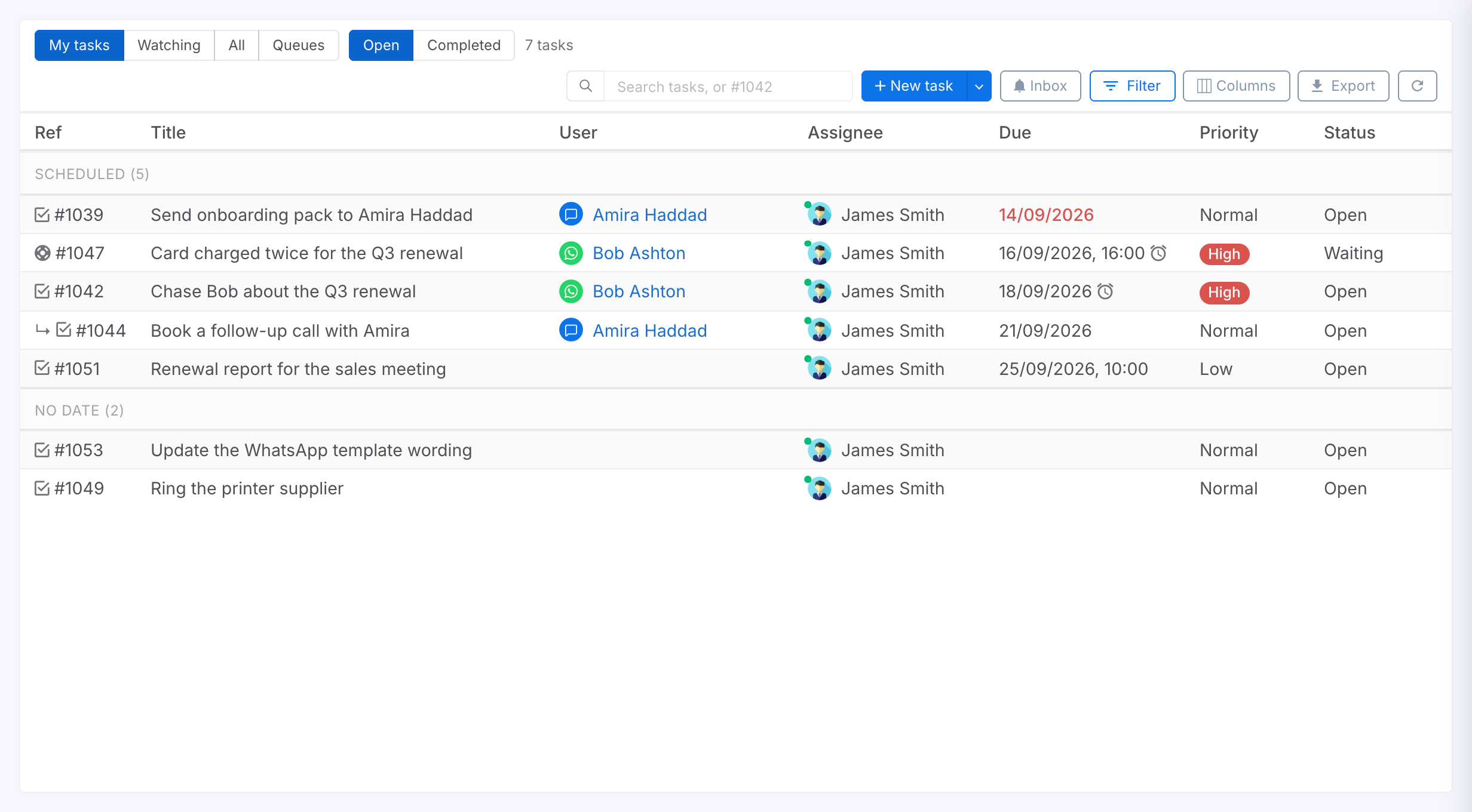
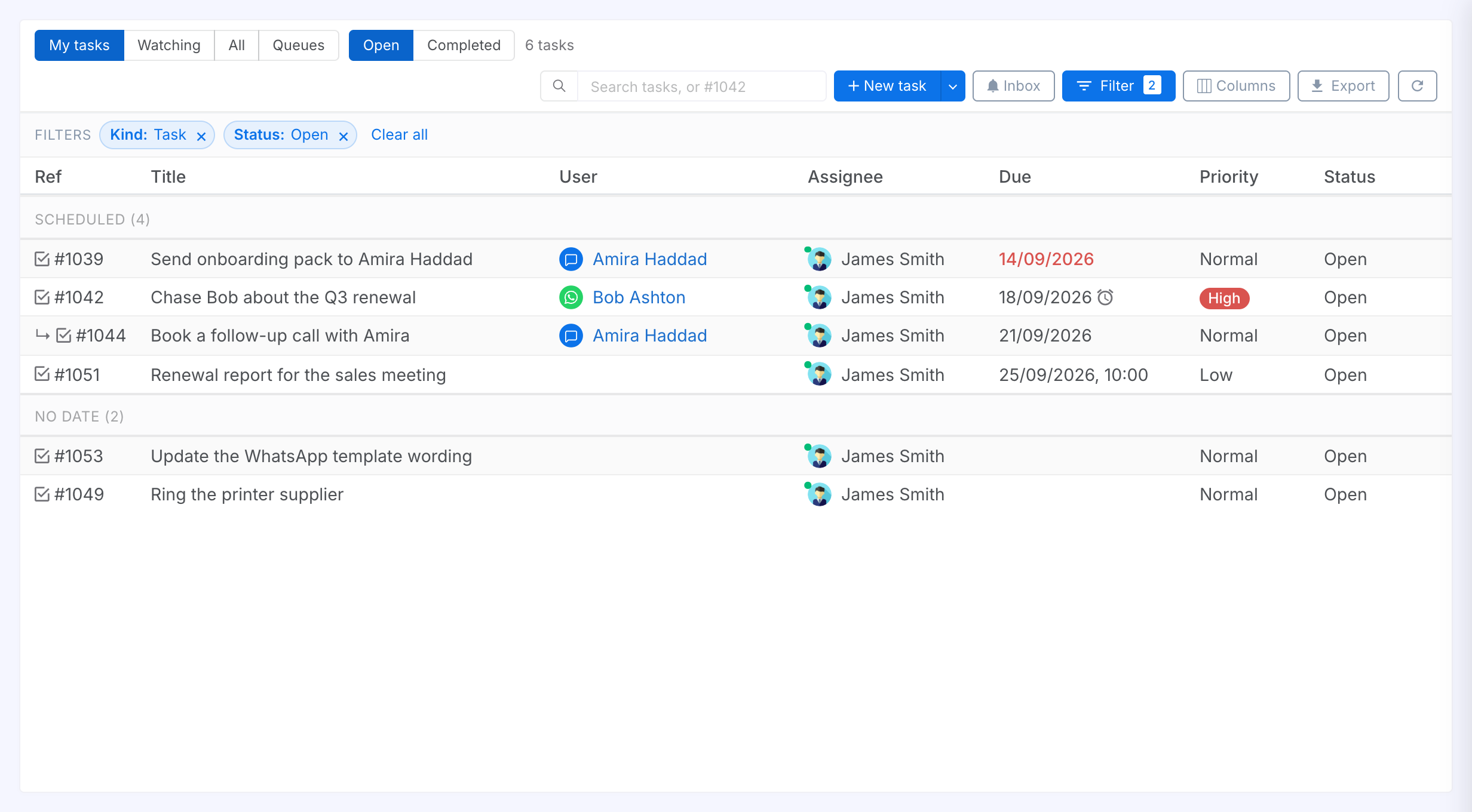
One table, with a toolbar above it. On the left, the view you are on and whether it shows Open or Completed work, with a count of what is listed. On the right, the search box, the New task button, the Inbox of your notifications, and the Filter, Columns, Export and refresh controls.
Click anywhere on a row to open the task. Click the name in the User column to open that user instead, or an assignee's avatar to see the agent.
Choose a View
The four views divide the organisation's work by your relationship to it. Open and Completed decide whether finished work is shown.
Result: Open shows work still to do. Completed shows what has been done, resolved or closed. Switching either refetches the list.
| View | What it lists |
|---|---|
| My tasks | Everything assigned to you. |
| Watching | Tasks you follow but are not doing: ones you created for someone else, commented on, were mentioned in, or chose to watch. Anything you have been pulled into has a home here after its notification is read. |
| All | Every task and ticket in the organisation you are allowed to see. |
| Queues | One Business Unit's ticket backlog, oldest first. See Tickets and Queues below. |
Read the List
Two sections, and a few marks worth knowing.
| Mark | Meaning |
|---|---|
| Scheduled / No date | Tasks with a due date come first, soonest at the top. Tasks without one follow, newest first. Each section loads 25 at a time. Click Load more at the foot of a section for the next page. The count in the toolbar gains a + while there is more. |
| Checkbox / life-buoy glyph | A task, or a ticket. Hover it for the word. |
| ↳ before the number | A subtask of another task. Open it to see its parent. |
| Red due date | Overdue. A whole-day date turns red once its day has ended, in your time zone. |
| Alarm glyph after the date | The task has a reminder set. |
| High pill | Priority High. Normal and Low are written plainly so High stands out. |
| Status | Open or Done for a task; Open, Waiting, Resolved or Closed for a ticket. |
Choose Columns
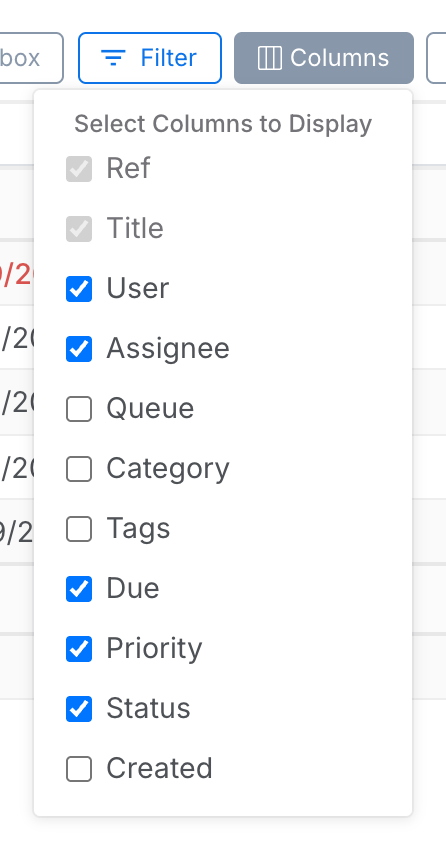
Show the columns that matter to what you are doing.
Steps:
- Click Columns and tick or untick a column.
Result: Ref and Title are always shown. Queue, Category, Tags and Created are off by default. They help when triaging a queue and are noise on a personal list. Your choice is remembered on this browser.
Export the List
Click Export to download the rows on screen as Tasks.csv, with the columns as shown. Load more first if you want the whole section.
Tickets and Queues
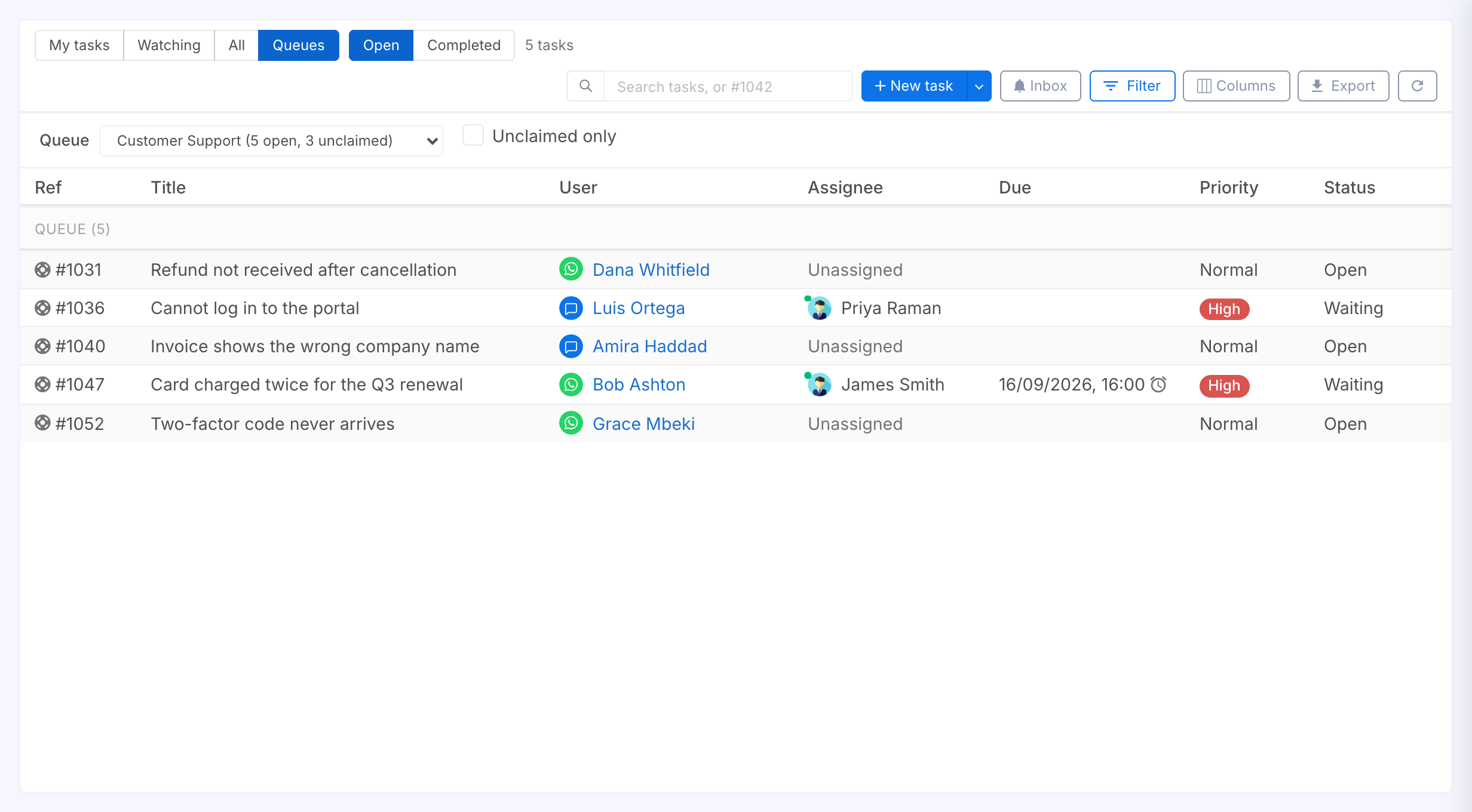
A ticket is raised about a user's request and put in a queue, one of your organisation's Business Units, where it waits unassigned for someone in that team to claim it. The Queues view is that backlog: one list instead of two sections, ordered by how long each ticket has been waiting, oldest at the top. A queued ticket is visible to the whole organisation, so a supervisor can look at any team's queue as well as their own.
Tickets have four statuses. Open is being worked. Waiting is parked on the customer. Resolved is done. Closed is finished without resolving it, with a reason such as Duplicate or No reply recorded in the ticket's activity. Categories such as Billing and Technical issue are set by an administrator in Ticket Categories.
Raise a Ticket
A ticket can be raised from here, from a chat, or from a user's card.
Steps:
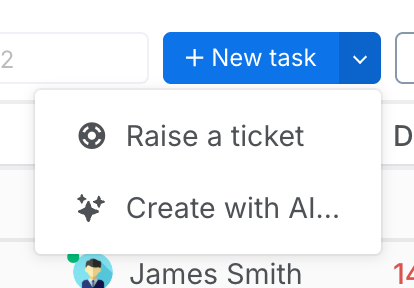
- Open the arrow beside New task and choose Raise a ticket. The window opens as a ticket, unassigned, in your own Business Unit's queue.
- Give it a title and a category, describe the request in the notes, then click Create task.
Work a Queue
Claim what is waiting and move it along.
Steps:
- Open the Queues view and pick a queue. Each entry shows how many tickets are open and how many are unclaimed.
- Tick Unclaimed only to see just the tickets nobody has taken.
- Open a ticket and set yourself as its Assignee to claim it. Set the status to Waiting while the customer owes you a reply, and Resolved or Closed when it is finished.
Result: A claimed ticket appears in your My tasks and stays in the queue's list, now with your name. Take yourself off it in the window to hand it back to the queue.
Filters and Search
Filters narrow the view you are on. Search looks across everything you can see (task titles, notes and comments) and opens the result in its window.
Filter the List
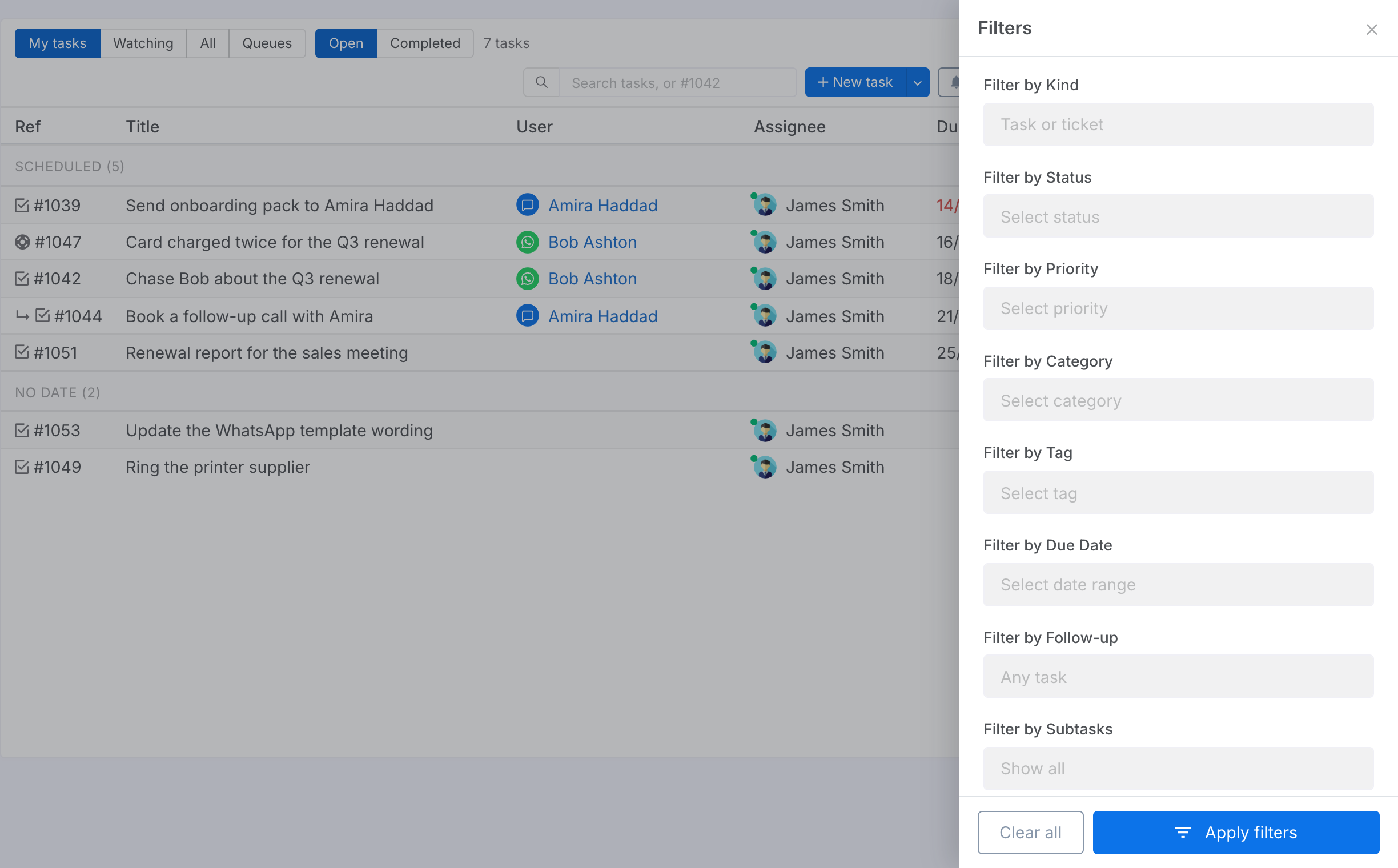
Narrow by kind, status, priority, assignee, category, tag, due date, follow-ups or subtasks.
Steps:
- Click Filter. The panel slides in over the list.
- Pick values in as many filters as you need. Several values in one filter mean any of them.
- Click Apply filters.
| Filter | Notes |
|---|---|
| Kind, Status, Priority, Category, Tag | The values a task carries. Status offers the ticket vocabulary, with Resolved / Done covering both kinds. A retired category is still offered, marked, so the tickets that carry it stay findable. |
| Assignee | Not offered on My tasks, or on a queue with Unclaimed only ticked. Those views have already decided whose work is listed. |
| Due Date | A date range. Tasks without a due date cannot fall inside one, so the No date section is hidden while a range is set. |
| Follow-up | Only the follow-ups that close themselves when the customer replies. |
| Subtasks | Hide subtasks lists top-level work only. Subtasks are otherwise listed as rows of their own, marked ↳. |
See and Clear Active Filters
The filters in force are shown as chips above the list, and the Filter button counts them.
Steps:
- Click the × on a chip to drop that one filter, or Clear all to drop them all.
Result: The list refetches at once. When nothing matches, the list says No tasks match your filters rather than leaving you to wonder whether the view is empty.
Search Tasks and Comments
Find a task by what it says, or a comment by what was said in it.
Steps:
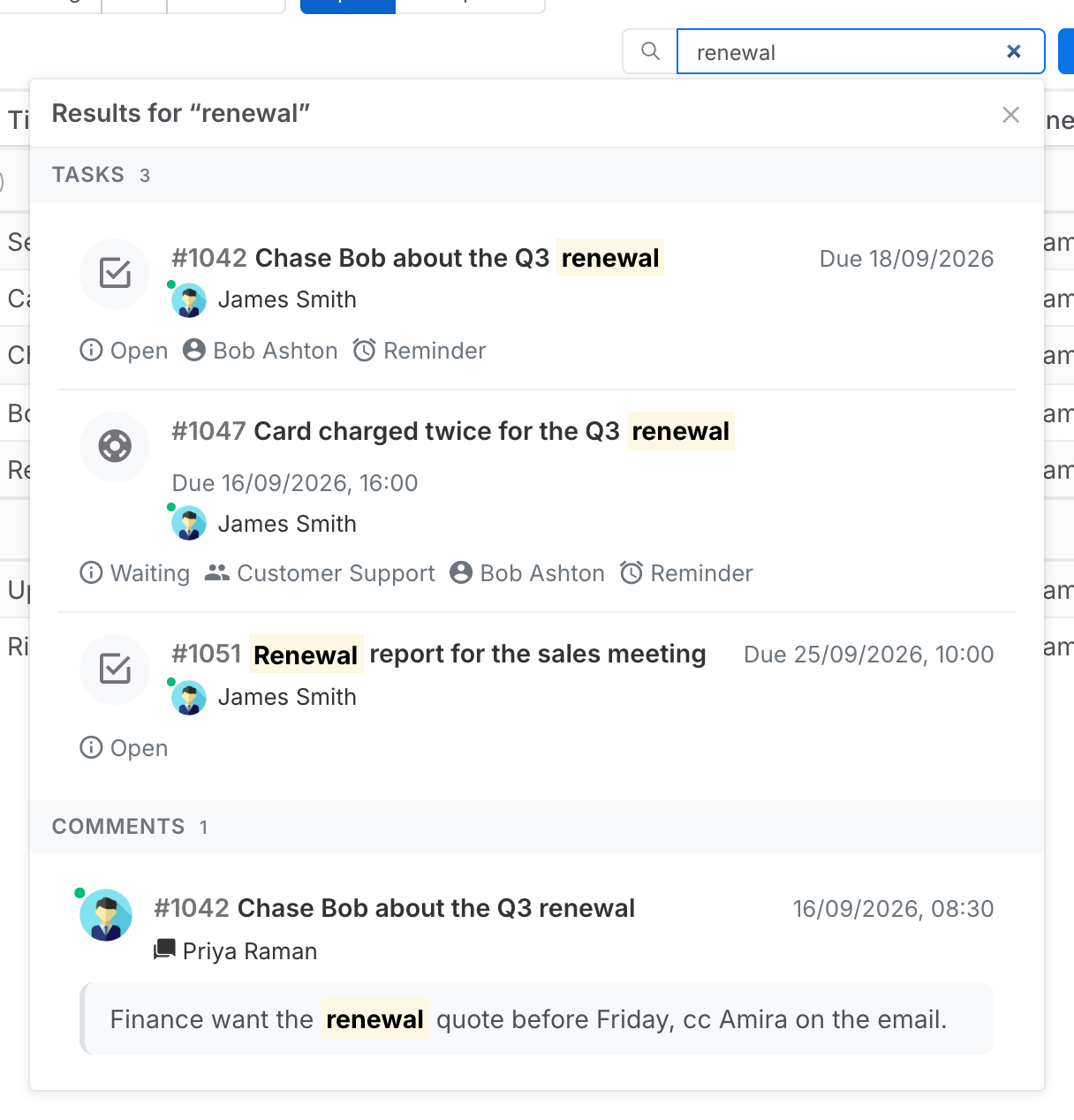
- Type in the search box and press Enter. The results drop down under the box, in two groups: Tasks matched on their title or notes, and Comments.
- Click a task to open it, or a comment to open its task with the thread on that comment. Load more at the foot of a group fetches the next page.
- Press Esc, clear the box, or click the × on the panel to close it. The list behind is untouched throughout.
- Type a task's number, such as #1042, and press Enter to open it straight away.
- Search covers everything you can see, whatever view or filters are on. The same search is available from the Search window's Tasks tab. See Searching.
Create a Task
The New task button opens a blank task in The Task Window, assigned to you. Its arrow offers the other ways in.
The New Task Button
One button, three ways to start.
| Entry | What opens |
|---|---|
| New task | A task, assigned to you, with nothing else filled in. |
| Raise a ticket | A ticket, unassigned, in your Business Unit's queue. |
| Create with AI… | The AI Task Assistant: paste notes or describe what needs doing and let it draft the tasks. Permission Required |